Showing posts with label memoir. Show all posts

Tuesday, August 20, 2013

Review: Chasing Chaos

Author: Jessica Alexander

Title: Chasing Chaos: My Decade in and out of Humanitarian Aid
Description: Alexander’s memoir details her adventures in aid programs in Darfur, Sierra Leone, Rwanda, Haiti, and Indonesia.
Source: Library Thing Early Reviewers
Writing style: Alexander is a gifted writer, combining anecdotes from her experiences and descriptions of some of the conditions she has worked in with commentary on the aid industry.
Audience: Anyone with an interest in international aid would enjoy it.
Major ideas: This book was really thought provoking. Probably many of us have hoped to make a difference internationally, but Alexander shows how difficult the job really is, even for those with many years of training. Sometimes those with very good intentions do more harm than good, but Alexander is generally understanding rather than cynical.

Wrap-up: I have nothing bad to say about this book. It was always interesting, and it taught me a lot about humanitarian aid. 4/5*

Tuesday, July 23, 2013

Review: FabYOUList

Title:  FabYOUList: List it, live it, love your life
Description: Cross was about to turn forty and was feeling a little unfulfilled, so she made a list of forty things she wanted to accomplish before then. One of them was to write a book—this book, as it turns out, which describes each of the goals and how she accomplished it.   
Source: Library Thing Early Reviewers
Writing style: Cross appears to have began her writing career as a blogger, and the style is very much a blogging style. She combines a little bit of humor with a didactic “you can do this too” kind of vibe.
Audience: Women.
Major ideas: Cross changed her life by doing these forty things (for example, ziplining, acting, camping with her kids, sunbathing nude, etc.), and she thinks that everyone has the same opportunity.

Wrap-up: I had mixed feelings about this book. A lot of it comes across as a bit superior/preachy. Some of her stories are interesting, but others are not. The idea of a bucket list isn’t new (I know, this isn’t technically a bucket list, but close enough), so I don’t think it’s revolutionary for someone to encourage people to have a bucket list and try to fulfill it. The stories of how it was done are what make this book unusual. By the way, if you would like to do this yourself, here's a great website!  I also recommend Twenty Wishes by Debbie Macomber—a book on the same topic although it’s fiction. 2.5/5*

Tuesday, July 16, 2013

Review: Persepolis

Title: Persepolis: The Story of a Childhood
Description: A graphic memoir (graphic as in like a comic book) about a girl growing up during the Iranian Revolution.
Writing style: The graphic novel style allows the words to be understated because the pictures can show emotion.
Audience: Everyone should read this. Because it’s about a young girl, it’s appropriate for students from about ninth grade on.
Major ideas: Satrapi wanted to let the rest of the world know that what happened in Iran was more complex than the version that made it to the West. There wasn’t a simple good guys vs. bad guys conflict; good guys became bad guys, victims became oppressors, and you never knew when your number would be up.

Wrap-up: This book has been widely acclaimed and used for lots of first year reads and One Reads, and with good reason. It’s easy, it’s quick to read, and it tells a story that most people don’t know. It's also been made into a critically acclaimed movie. 5/5* 

Tuesday, May 28, 2013

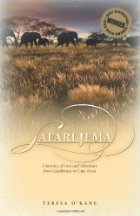
Book Review: Safari Jema

Author: Teresa O’Kane
Title: Safari Jema

Description: O’Kane and her husband take several months to make an overland tour of Africa, starting in the north and ending up in South Africa. This is the story of their journey.  
Source: One of seven books nominated for Foreword’s award in the travel category (I’m a judge this year).
Writing style: O’Kane is funny and self-deprecating. The incidents she chooses to relate are usually quite interesting, but the book overall comes across as a little too loosely connected & episodic.
Audience: People who enjoy reading accounts of travel and different cultures.
Major ideas: It’s possible to travel if traveling is really your dream. If you are prepared for a little discomfort and open to others, you can have some wild adventures.

Wrap-up: This book ended up in second place in my list of honorees. I enjoyed it because of O’Kane’s attitude of wonder, curiosity, and acceptance, and because of her knack for knowing what would be interesting to a reader and what might come across as merely boring. I don’t know if I could endure parasites in my feet, though—I’d prefer to just read the book! 4/5*

Thursday, May 23, 2013

Book Review: The Unsinkable Mr. Brown

Author: Brian David Bruns
Title: The Unsinkable Mr. Brown

Description:  Bruns (his name means “Brown” in Romanian, thus the title) arrives in Romania to visit a girl he barely knows, Bianca. The first part of the book describes their time together in Romania; when they fall in love, Bruns decides to join her in her occupation—crewing on a cruise ship. He starts as a waiter, a job which is almost never held by an American, and moves up to working the art auctions.
Source: One of seven books nominated for Foreword’s award in the travel category (I’m a judge this year).
Writing style: Humorous and a bit disjointed.
Audience: Would probably appeal more to humor readers than travel readers, though Bruns has gained somewhat of a following among cruisers for his other books about life as a Carnival employee.
Major ideas: Working on a cruise ship isn’t as glamorous as you might think.

Wrap-up: I enjoyed this book, but I did find it somewhat scattered. I wasn’t convinced by the love story either; Bianca comes across as capricious and self-centered. 3/5*

Tuesday, May 21, 2013

Review: Among the Islands


Author: Tim Flannery
Title: Among the Islands: Adventures in the Pacific

Description:  I’m reading lots of travel  books for the contest, but this was one I just happened to pick up from the library at the same time. Flannery, a mammal specialist from Australia, made several journeys to remote islands in the South Pacific doing animal surveys. He explains the theories of mammal migration—how mammals made it to these very remote islands. Unfortunately, small islands only support small mammals, so most of the book is about rare bats and rats. Flannery is enthusiastic enough about them to make a fairly interesting read.
Writing style: The book reads like a travelogue; Flannery knows enough to write about the islanders and his coworkers as well as the small mammals he encounters and has a good ear for interesting scenes.
Audience: The book will appeal most to those who enjoy accounts of travel and to those who are interested in natural history.
Major ideas: There are still undiscovered species, and there is a chance to save endangered species, but as habitat is destroyed by human settlement and logging, the chance is rapidly diminishing.
Wrap-up: I didn’t regret reading it, but it wasn’t what I had hoped for. 3/5*

Sunday, May 5, 2013

Review: Dark Waters


Author: Jason Lewis

Title: Dark Waters (The Expedition Trilogy, Book 1): True Story of the First Human-Powered Circumnavigation of the Earth
Description: Lewis and his partner attempt a circumnavigation under only their own power. This book is first in a planned trilogy, and covers the building of their pedal boat, the Moksha, their bicycle ride across Europe, their Atlantic crossing, and their crossing of the U.S., Stuart by bicycle, and Jason by roller blade.
Source: One of seven books nominated for Foreword’s award in the travel category (I’m a judge this year).
Writing style: Lewis is funny and pretty self-aware. He admits his shortcomings when he sees them. Lewis moves fluently between life-threatening danger—rogue waves, pirates, lack of food—daily drudgery, and his efforts to discover the meaning of life.
Audience: those who enjoy high adventure.
Major ideas: Writing about the meaning of life (or trying to) is a dangerous temptation. All too often, someone will spend hours in meditation and contemplation and come up with profound revelation, only to fail hopelessly to put it into words that rise above the trite. Of course, I’m tempted to go into long digressions here about the nature of language and its relation to reality, but I’ll resist.  I’ll also refrain from telling you the meaning of life—it’ll be much more exciting when it’s revealed to you in the book.
Wrap-up: Definitely worth a read. 4/5*

Saturday, May 4, 2013

Review: Kilimanjaro


Author: MG Edwards
Title: Kilimanjaro: One Man’s Quest to Go Over the Hill

Description: Edwards decides to tackle Kilimanjaro as a sort of midlife challenge to himself as he debates the path his life will take in the future. With three like-minded friends, he plans an attempt on Kilimanjaro. He takes us with him through the process from planning to aftermath.   
Source: One of seven books nominated for Foreword’s award in the travel category (I’m a judge this year).
Writing style: Edwards’ writing style grew on me. He gives some personal detail without giving too much information, and the same can be said of the climbing detail. The result is a saga of the trip that doesn’t get bogged down or go too fast. He does seem to relate his own climb to Hemingway’s Snows of Kilimanjaro story a little much—the book would stand on its own without this conceit.
Audience: Those who enjoy first-person travel narratives or stories of people tackling bucket-list type quests.
Major ideas: Edwards knows that the climb will be the most physical challenge he has ever tackled. He’s having difficulties in his career, and figures if he can master Kilimanjaro, he can face the challenge of changing his life’s path in other ways.
Wrap-up: I enjoyed this book. It’s an independent publication, so the quality (i.e. small black and white pictures) could have been better, but overall, I would recommend. 4/5*

Saturday, April 27, 2013


Author: Ruth Reichl
Title: Comfort me with Apples

Description: Reichl is the master of the food memoir. She recalls her life through meals she had at different times with different people—though that’s really putting it a bit simply. She remembers events and food events at the same level, and excels at describing both to the reader.   
Source: This was my choice for our book group read.
Writing style: Oh, she is so sensuous. She can describe the taste, the experience of food like no one else; she uses all her senses to encounter a meal and then replays it for us.
Audience: foodies, memoir readers
Major ideas: The book is about a difficult time in Reichl’s life: the breakup of a marriage and a romance and her experiences with infertility. She’s pretty honest with the reader about her own failings, but we forgive her because she writes so beautifully.
Wrap-up: I’m a fan, and gobbled this book up. I just wish I had someone to cook the recipes at the end of each chapter for me! 5/5*

Sunday, June 24, 2012

Book Review: Some Assembly Required

Author: Anne Lamott
Title: Some Assembly Required: A Journal of My Son’s First Son
Description : Anne Lamott’s son Sam learned that he and his girlfriend, Amy, would become parents when Sam was just nineteen. Lamott, who wrote about Sam’s first year in Operating Instructions, continues the tradition here with the first year of her grandson Jax.
Writing style: Classic Lamott. She writes here in journal form, with dates as headings, rather than chapter titles. There are some passages written by others: friends, family, and especially Sam, who receives co-author credit.
Audience: Christians, non-Christians,  parents, grandparents, teens, people who hope to be parents, sober people.
Major ideas: As much as we love those who are closest to us, we cannot live their lives or make their decisions for them. Everything does not revolve around me, even when I think it does.
Wrap-up: I’ve called Anne Lamott my literary bff, so I wait for every one of her books like kids wait for Christmas. She has preceded me in life by just a little: Sam was nineteen at the beginning of this book, and my own son is seventeen now. So I read her books and learn from her and try to remember what she has taught me. She’s funny and wise and real. 5/5*

Wednesday, June 6, 2012

Book Review: Still

Author: Lauren Winner  
Title: Still: Notes on a Mid-Faith Crisis
Description: I’ve followed Lauren Winner for at least eight years now, first in her account of her conversion, Girl Meets God, through her struggle with remaining chaste as a single Christian and as she gradually got to know the man she would eventually marry in Real Sex. So I was sad to see that this book is a result of her divorce, five years later. Not quite a memoir, the book is composed of the short essays that Lauren does so well.
Writing style: The best word to describe it is “spare.” Lauren writes that she tries to leave spaces in her writing as a result of her reading poetry, and I would say that is a pretty good way to describe the book. The essays range from about a half a page to several pages in length—not as long as in Girl Meets God.
Audience: Readers of spiritual memoir; those struggling with their faith after a difficult time, especially divorce.
Major ideas: Lauren’s divorce and the death of her mother precipitate a crisis of faith. The book is divided into three sections, tracing the feelings of God’s absence and the very gradual return of something that could be normalcy and renewed relationship with God.
Wrap-up: Lauren Winner remains one of my very favorite authors, and I couldn’t read this book without feeling sad for her in a very personal way. Her meditations on faith—or here, sometimes, the lack of it—are always insightful and memorable. The joy of Girl Meets God is absent here, but I hope she’ll return to it in time. 5/5*

Saturday, April 7, 2012

Book Review: Smashed

Author: Koren Zailckas  
Title: Smashed: Story of a Drunken Girlhood
Description: Painfully shy and awkward in social situations, Koren Zailckas began drinking (and getting drunk) when she was fourteen. Her  stealth and her parents’ denial—despite having to have her stomach pumped at age sixteen—allowed her to continue her pattern of frequent drunkenness through college. This memoir gives a chronological account of her life during that time interspersed with facts about young women and drinking.
Writing style: The writing is surprisingly lucid, considering that most of the book is about being drunk. I’m surprised she could actually remember what happened at the level of detail that she did. By the end of the book, I imagined that I could actually feel what it was like to be drunk—pretty remarkable, since I’m a lifelong teetotaler. I would come away from the book reeling a little, and with a headache.
Audience: This book would be a good read for anyone who enjoys memoirs, for young women, and for anyone who is struggling—or knows someone struggling—with an alcohol problem.
Major ideas: Zailckas contends near the end of the book that while she was a problem drinker, she was not an alcoholic. This has caused some controversy, but I didn’t have a problem with it; the main thing was that she finally realized that she hated how she felt while (and after) she was drunk and that she couldn’t continue to abuse alcohol.
Wrap-up: This book is extreme; it caused me to wonder things like “What were her parents thinking?” “How on earth could she pass even one class in college?” and “How did she manage not to kill herself?” Mostly, it’s a cautionary tale about how our society’s glorification of drinking, and ignoring of problem drinking, can nearly wreck a life before it gets started. It doesn’t get a higher rating because it nearly caused me to become ill every time I picked it up, but it is extremely well-written. 3.5/5*

I'm claiming this book for three reading challenges: the new author challenge, the unread books challenge and the Memorable Memoirs challenge (4/4).

Sunday, April 1, 2012

Book Review: Paris in Love

Author: Eloisa James
Title: Paris in Love
Description: Romance writer and Shakespearean scholar Eloisa James and her husband and two children take a sabbatical year in Paris after her brush with breast cancer. Sometimes a travelogue and sometimes just musings on parenthood, marriage, and life in general.
Source: Library Thing Early Reviewers
Writing style: If there was anything that put me off a little about this book, it was the style, which was mainly short, disconnected paragraphs. In the introduction, the author describes how she kept in touch via tweets and facebook updates and used them as the starting point for much of the book. Some of the paragraphs are just beautifully written, but overall, there was a little too much disconnection for me.
Audience: The book should appeal to those who enjoy memoir and travel books; it will have a built in readership of Eloisa James fans.
Major ideas: Maybe the French just know how to embrace themselves and their lives in a way that is fully engaged.
Wrap-up: Please don’t let the endorsement from Elizabeth Gilbert throw you off. This book is nothing like hers.  I mentioned my only caveat above. Mostly I really enjoyed this book, by one of my favorite romance authors. Her son is about the age of my son, so many of her stories really struck a chord. 4/5*

I'm claiming this book for the memoir challenge (3/4). 

Monday, February 20, 2012

Author Interview: Donna Johnson, Part II

Continued from Part I...

One of the most alarming parts of your book comes when  your mother leaves you with strangers in order to dedicate herself more completely to the Lord’s work (or Terrell’s work). Did you ever discuss with your mother how her work with Terrell affected her parenting? Did she ever indicate that she regretted her choice? Since your father was largely absent from your life, did Terrell ever become in any way a surrogate father?

I have discussed my mother's choices several times with her throughout my life and she has apologized many times. She absolutely regrets many of her choices. Don't we all? As for Terrell, I say at the beginning of the book that he was as close to a father figure as I would get. Once my mom stopped traveling, he supported our family. We looked forward to him coming home. He was kind to me and my brother. He sold one of his trucks to buy my first car. He was a sort of distant father figure, as were many men of his generation.

How would you characterize the pull that followers feel when their religious leader directs them in ways they believe to be wrong, or strongly misguided? 

I think it's like growing up in an alcoholic family. You know something is wrong, you can feel it, but the people you trust keep telling you that everything is okay. And so you are deeply divided. You believe what you are told more than what you perceive, and therein lies the problem. 

There is a certain innocence for kids with this kind of upbringing—it was not our choice, after all, to follow this charismatic, but dangerous, leader. What sense do you have of what it does take for an adult to turn her life over completely to a near-stranger?

I think the overall impetus often comes when an individual is seeking meaning, or at least something "bigger" or more important than what he or she finds in everyday life.  Once people find someone who seems inspired and willing to provide answers, perhaps they are relieved that they no longer have to carry the burden of that seeking. It becomes the leader's job to provide answers, and the people's job to believe.  And of course fundamentalist religion casts doubt in such negative terms. I think that's probably the most negative thing about fundamentalism of all kinds, it discourages doubt and critical thinking. And that leaves people open to the worst sorts of abuse. Perhaps a better, or more helpful, mode of religion would point us all back toward to our own hearts, something like the Buddhist perspective that the answers lie within.

It seems to me that our generation would never give up autonomy in the same way our parents’ generation did. Can you discuss what it might have been about that particular time in history that perhaps produced a certain kind of person who was ready and eager to become a follower?

I think there are people who are always ready and eager to become followers, but I also think that earlier generations were taught be more accepting of authority. We have since seen so much abuse of authority, in almost every institution, that trust seems overly naive. Part of the 1960s ethos was to question authority and perhaps we've carried that forward. However, there are many today who follow the party line without  questioning, who accept the politically correct or  the conservative point of view without question. I think it's a very real danger to democracy and part of why the cultural divide is so deep.

The book pretty much ends as you come of age. Do you feel that you’ve been able to lead a “normal” adult life? How did your childhood affect you as an adult?

The answer to this question depends on how we define normal. I married, had children, furthered my education and have had what most would deem a successful career--so on paper I sound normal. My childhood has affected my adult life in a myriad of ways--as childhoods do. For a long time stability felt like a kind of death. I've had several failed relationships and marriages. The sameness of day-to-day life grated on me, and sometimes still does. As a result, I don't think I was a great mom--and that is very painful for me. I hate that my childhood has affected my daughter. On the positive side, the Jesus message of housing the homeless, feeding the hungry and clothing the naked has stayed with me. I have a deep empathy with outsiders that I think comes from that emphasis of caring for one's neighbors, with the idea being that we are all neighbors.

Thanks a bunch to Donna Johnson for this interview; I'm looking forward to her next book!

Sunday, February 19, 2012

Author Interview Donna Johnson, author of Holy Ghost Girl

A few weeks ago I posted a review of Holy Ghost Girl, about a family who traveled with a revival preacher in the 1960's. The author of this book, Donna Johnson, graciously agreed to answer my questions about the book. Here is part 1 of the interview; part 2 is coming soon!

Did you hold on to any of the religious beliefs of your childhood? 


I carry a belief in social justice that stems from the teachings I absorbed as  a kid. I inherited the idea that there is something huge and mysterious afoot in the world, though I think that religion often makes that "something" too small by trying to define it. I am a sort of cultural Christian, much more of a contemplative. I read Buddhist writers and thinkers and they have influenced the way in which I think about existence. I would like to feel more connected to my own tradition, but find I still have quite a bit of resistance, even though I've attended an Episcopal church on and off and years.


As I mentioned in my review, I was expecting a sort of tongue-in-cheek sendup of the “crazy Pentecostals,” but your book is a far cry from that. You seem to be writing from a position of ambivalence – an even-handed acknowledgement of the good hand-in-hand with the bad. Would you say there was more good? Or more bad? Would you trade your childhood for a “normal” childhood?

I don't know if there was more good than bad. On a day to day basis, there may have been more bad times than good. But there was also great deal of love, and that redeemed my childhood to a large extent and gave me some sense of goodness in the world. In terms of trading my childhood for a normal one--because of my daughter and because I now see so much dysfunction being passed down through the next generation, I have to say yes, I would trade my childhood for something more normal. I would have liked to have had an experience of stability and safety to pass on.


If a religious leader is going to have “feet of clay,” it often seems to be in the area of sexuality. Why do you think that sexual sin is so common among admired Christian men?

I've thought a great deal about this. Statistics show that divorce and affairs are as common in the church as outside of it, so I don't know that Christian men are more prone to sexual misconduct. Several Buddhist leaders and Hindu holy men have been accused of misconduct similar to Terrell's in terms of money and women. I tend to think that power is a corrupting force. Look at the secret and not so secret lives of performers and politicians. I think sexual misconduct stands out in Christian and religious circles because we expect more from these men, as we should. Terrell's sexual misconduct was on a grand scale, more like a rock star's maybe. But I do not think it is an anomaly in any circle, especially where there is unchecked power and ego.

Your brother was younger than you. How has he reacted to the upbringing the two of you shared?


My brother has recreated a life style that is similar to the one in which we grew up with a couple of large exceptions: he treated his wife far better and he didn't leave his children behind. He often says he doesn't like to talk about the past, but I think it is because it is so very painful for him.  And I'm not sure that talking about it makes it any better or any less painful.


Your book describes a kind of parallel existence with kids in the rest of the world—for example, the scene where some of you visit a local swimming pool, where the town kids watch you swim in your church clothes—because you don’t own bathing suits. Did you (collectively) feel superior to “normal” kids? Envious? Can you describe how you came to realize that you had something in common with them? As an adult, do you now feel “assimilated,” or do you still have something of that wall between you and outsiders?

We felt both superior and inferior to "worldly" kids. We knew we were different and to compensate for that difference, we feigned superiority. I say feigned, but we were taught that we were the elect, the chosen ones and we absorbed that teaching. In later years, as a preteen, I was very envious of normal kids. I think I first realized I had something in common with the rest of the world through reading. Good books allowed me to see the commonality of humanity. I never discussed my innermost feelings with anyone until I reached my twenties. I am certainly more assimilated than I've ever been, but it's been a long process, and yes, I still often feel like an outsider. It's habit. I have to remind myself on occasion that the reality is I am no longer an outsider and have not been for a long time.


Watch for part 2, coming soon!

Saturday, February 4, 2012

Book Review: Holy Ghost Girl

Author: Donna M. Johnson
Title: Holy Ghost Girl: A Memoir
Description: A single mother with two small children, Donna Johnson’s mother still felt a call to the ministry which prompted her to leave her Assemblies of God clergy parents’ home to join the entourage of revivalist David Terrell.  A tent-preacher in the faith-healing tradition of Oral Roberts, Terrell and his small group of followers traveled from town to town, mostly in the civil rights era South, holding revival meetings. From the time she was a toddler, Johnson grew up attending several preaching services a day, witnessing healings and speaking in tongues as everyday events, and associating only with other holiness converts.
ARC source: I received this book as a part of the Library Thing Early Reviewers program.
Writing style: Previous books that I’ve read in this genre tend to be pretty tongue-in-cheek, demonstrating that the author now knows better than to believe all that claptrap. And you have to admit that this type of lifestyle, while not generally prone to drunkenness and high living, has its own extremes. I was surprised at Johnson’s even-handed approach. While she does not cover up the flaws of the adults involved (Terrell was sexually involved with several women in the group in addition to his wife and Johnson’s mother seemed to have many priorities higher than parenthood), she also readily affirms the good memories and the seemingly miraculous events that surround Terrell.
Audience: This book will appeal to those who enjoy reading memoirs and those interested in revivalism and religious history.
Major ideas: Although Johnson felt like her family was mostly broken, as an adult she comes to realize that perhaps she can define “family” in a way that will include the jumble of people who surround David Terrell. She also seems surprised that she has managed to become as normal of an adult as she seems to be.
Wrap-up:  I had a not dissimilar upbringing, so maybe I was way more fascinated by this book than other folks would be, but it still struck me as being gracefully written, evenly paced, and always fascinating. 4.5/5*

I'm claiming this book for two reading challenges: the new author challenge (9/15) and the Memorable Memoirs challenge (2/4).

Sunday, January 8, 2012

Book Review: Join Me

Author: Danny Wallace 
Title: Join Me
Description: Danny Wallace (for a reason while I’ll let him explain to you) decides to place an ad asking people to join him by sending a passport photo. They do. What results is a collective, not a cult. To tell much else would be to present spoilers, since really not much actually happens in this book. Danny has done some silly things in the past, and conceived of a few more; his no-nonsense girlfriend calls these boy-projects and refuses to have any part of them.
Writing style: Wallace has a clever and funny writing style, which is really the point of this book. While I don’t know that I laughed out loud, I certainly enjoyed his sense of humor and read the book in about three days.
Audience: Those who enjoy humorous memoir (or really any type of memoir) will enjoy this book.
Major ideas: We can make the world a better place just by being friends and thinking of others. Don’t deceive your significant other.
Wrap-up: This was a very British book, full of pints and chips and other British things, including British humor, which can be irresistible if done well. 4/5*

I'm claiming this book for three reading challenges: the new author challenge (4/15), the unread books challenge, and the Memorable Memoirs challenge (1/4).

Tuesday, August 9, 2011

Book Review: Oh, Mexico


Author: Lucy Neville

Title: Oh, Mexico: Love and Adventure in Mexico City

Description (source): Adulthood inevitably encroaches on all of us, but it is how we choose to acknowledge it that crafts our own story. For Lucy Neville, the reality of life after college did not provide the adventure she was seeking. Instead of taking the conventional route and starting a career, Lucy longs to further her learning of the Spanish language.  She decides the best way to do so would be to immerse herself in a Spanish speaking culture, and the obvious choice for most young women would be Spain. Instead, Lucy moves to Mexico City without the safety net of money, contacts, or even a thorough understanding of the language and despite the warning of the dangers at every turn. To Lucy, this is all part of the draw.
And so begins a young woman's hilariously dysfunctional love affair with a strange yet energetic city. Lucy quickly finds a job teaching English as a second language and discovers several culturally characteristic personalities as she adjusts to this new world. Against the backdrop of dangers like kidnapping, corruption and drug wars, alongside the delights of Mexican dance and street food, Lucy finds herself in outrageous situations, in both love and life in general. Landing a role in the famous Latin American soap opera, Tequila Loving, and managing to fall in love with two men, Lucy is an unpredictable spirit that proves irresistible to the reader. Her adventures culminate with the arrival of her eccentric relatives - where culture, a love triangle, and truth collide. (Marketing copy)

ARC source: netgalley

Writing style: Lucy has a wonderful writing style for this type of book and blends cultural observations with her own personal encounters in just the right proportion.

Audience: nonfiction, memoir, travel readers. This is the kind of book I would pick up, so I was predisposed to like it.

Major ideas: One reason that I really like to read books about peoples’ encounters as they live in foreign countries is that this is something I’m really drawn to, but because I have commitments, I’m past the stage of life where I can pull up stakes and move to Mexico or Peru. Or else I haven’t hit it yet. Or, a little voice whispers, I’m just not brave enough to show up in a country where I don’t speak the language, have no job and very little cash, and see how I get by. But I am brave enough to read about it.

Wrap-up: I enjoyed this book tremendously and would have enjoyed it had it been twice as long. Lucy has the generosity of spirit to accept people as they are, even when they are quite odd. For this reason, we’re given a sort of wide-eyed, yet not naïve, view of this exciting and vibrant country. Not to mention I wanted to try all of the food except for the stew that was made to mimic Aztec-human-sacrifice-stew. 4/5*

Thursday, June 30, 2011

Book Review: Growing up Amish

Author: Ira Wagler
Title: Growing up Amish
Description (source): One fateful starless night, 17-year-old Ira Wagler got up at 2 AM, left a scribbled note under his pillow, packed all of his earthly belongings into in a little black duffel bag, and walked away from his home in the Amish settlement of Bloomfield, Iowa. Now, in this heartwarming memoir, Ira paints a vivid portrait of Amish life—from his childhood days on the family farm, his Rumspringa rite of passage at age 16, to his ultimate decision to leave the Amish Church for good at age 26. Growing Up Amish is the true story of one man’s quest to discover who he is and where he belongs. Readers will laugh, cry, and be inspired by this charming yet poignant coming of age story set amidst the backdrop of one of the most enigmatic cultures in America today—the Old Order Amish. (Marketing Copy)
ARC source: Netgalley
Writing style: Wagler does a good job of combining the big picture with single incidents that illustrate his points. The narrative kept my interest throughout, moving along quickly enough that it doesn’t get bogged down.
Audience: The book should appeal to fans of Amish fiction; I think most of them are women, and this book, written as it is from an Amish man’s point of view, gives another side of the picture. It will also appeal to anyone who enjoys reading memoirs. I grew up in Amish country, so I was more interested in this topic than many people would be, but I did not “laugh, cry, and get inspired” as the marketing copy promised.
Major ideas: Wegler keeps to the point throughout, which is his ambivalence about the Amish lifestyle. He describes both the appeal and the downside of being Amish; if there was a drawback here, it would be that he seems at a remove from his younger self—almost as if we are looking down at him rather than inhabiting him. I imagine the young Ira was very confused, so maybe that is a good thing.
Wrap-up: I liked this book. I found myself wondering what choice Ira would ultimately make, and how he would find his place in the world, since he didn’t seem to fit in either the Amish or the “English” culture. 3.5/5*

Wednesday, June 22, 2011

Book Review: Unfinished Business

Author: Lee Kravitz
Title: Unfinished Business: One Man’s Extraordinary Year of Trying to Do the Right Things
Description (source): After losing his job, Lee Kravitz—a man who had always worked too hard and too much—took stock of his life and decided to spend an entire year making amends and reconnecting with the people and parts of himself he had neglected. (cover)
ARC source: Library Thing
Writing style: Kravitz knows how to tell a good story, and I like the format of the book: an introductory chapter, followed by a chapter on each of the matters of unfinished business he needed to tend to.  The book got a little repetitive toward the end, as Kravitz reminds the reader several times what he’s doing and why. It’s almost as if the chapters were being published separately, so each one has a little back story.
Audience: People who like memoirs/quests; that would be me.
Major ideas: The idea and its execution are the strongest part of this book. Everyone has regrets, and the idea of going back to see what happened or to try to make amends is something everyone can relate to. I’ll bet everyone who reads this book starts to wonder, “If I had written this book, who would be the stars of my story?” Kravitz includes some stories from readers—his own quest did start others thinking. He has a blog that continues the story.
Wrap-up: I enjoyed the book very much and I know I’ll think about it frequently over the next few weeks. It’s definitely worth a read. 4/5*